
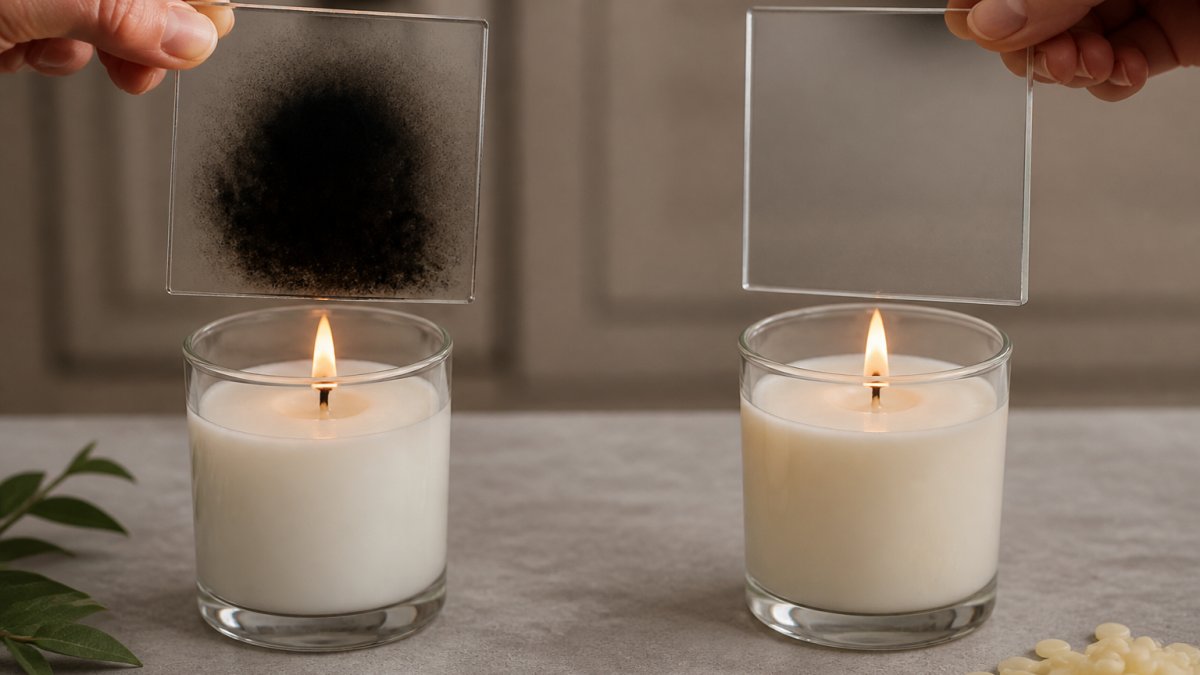
Why Soy Candles Produce Less Soot
Table of Contents
- Understanding What Candle Soot Actually Is
- Why Soy Candles Produce Less Soot Than Paraffin
- Soy vs. Paraffin Candles: A Direct Comparison
- Common Causes of Soy Candle Soot
- How to Trim a Candle Wick and Stop Soot
- How to Stop Candle Soot: A Practical Checklist
- Soy Candles and Indoor Air Quality
- Frequently Asked Questions
Last Updated: October 11, 2026
Understanding What Candle Soot Actually Is
Candle soot is the black residue that builds up on walls, ceilings, and around lamp shades when you burn a candle. It forms during incomplete combustion, when the flame doesn't have enough oxygen to burn all the fuel completely.
Soot differs from smoke. Smoke is visible vapor that rises from the flame. Soot is the solid particles left behind. You might see both when a candle burns poorly, but soot is what leaves that permanent dark mark on your walls.
Understanding what soot actually is matters because it changes how you think about preventing it. It's not just about the wax type, it's about how completely that wax burns. That's where soy wax enters the picture.
Why Soy Candles Produce Less Soot Than Paraffin
Soy candles produce less soot than paraffin candles because soy wax burns more completely. Complete combustion means the fuel converts fully to carbon dioxide and water vapor instead of leaving behind unburned carbon particles.
The combustion difference between soy and paraffin wax
Paraffin is a petroleum byproduct. It's a dense, heavy wax that requires more heat to burn completely. When a paraffin candle flame doesn't get ideal conditions, the right oxygen flow, proper wick size, or stable burn environment, incomplete combustion happens more easily. Incomplete combustion leaves carbon particles behind, which become soot.
Soy wax comes from soybean oil. It's a plant-based fuel with a different molecular structure. Soy burns at a lower temperature and more cleanly. The fuel ignites more completely with less excess carbon left over.
However, this doesn't mean soy candles are soot-free. They can still produce soot if conditions are poor. A soy candle with the wrong wick size, burned in a drafty room, or overloaded with fragrance will still leave black marks.

Fuel consumption and incomplete combustion
How fast a candle burns affects how much soot it makes. Paraffin wax burns faster and hotter than soy. A faster burn rate means the flame has less time to fully combust all the fuel molecules. More fuel reaches the flame faster than oxygen can process it. That mismatch creates incomplete combustion and soot.
Soy wax burns slower. The slower burn rate gives the flame more time to fully consume the fuel. Oxygen has time to reach all the fuel molecules. Complete combustion happens more often. Less unburned carbon escapes as soot.
This is one reason why soy candles produce less soot, the fuel itself burns in a way that favors complete combustion. But the wick size and burn conditions still matter enormously.
Soy vs. Paraffin Candles: A Direct Comparison
| Factor | Soy Wax | Paraffin Wax |
|---|---|---|
| Soot production | Lower when properly maintained | Higher, especially in poor conditions |
| Burn temperature | Lower, more stable | Higher, less stable |
| Burn rate | Slower | Faster |
| Combustion efficiency | More complete | More prone to incomplete combustion |
| Fragrance throw | Strong and consistent | Can be strong but variable |
| Cost | Higher | Lower |
| Environmental impact | Plant-based, renewable | Petroleum-derived, non-renewable |
Soy candles have a real advantage in soot production. But that advantage disappears if you don't maintain them properly. A well-kept paraffin candle produces less soot than a neglected soy candle.

Common Causes of Soy Candle Soot
Even premium soy candles produce soot when conditions go wrong. The wax type is only part of the equation.
Wick size and wick maintenance
The wick is the most common culprit. A wick that's too thick creates a flame that's too large. A large flame consumes fuel faster than oxygen can reach it. Incomplete combustion happens. Soot forms.
A wick that's too thin creates a weak flame that can't burn all the fuel. Unburned wax pools around the wick. This also produces soot and smoke.
The right wick size creates a flame about 1/4 inch to 1/2 inch tall. The flame should be steady, not flickering or dancing. If your soy candle produces soot from the first burn, the wick is probably the problem.
Wick trimming prevents soot buildup over time. As you burn a candle, the wick gets longer. A longer wick creates a bigger flame. That bigger flame produces more soot with each burn.
Fragrance load, dyes, and additives
Fragrance oil, dyes, and other additives affect how cleanly a candle burns. Too much fragrance oil makes the fuel mixture harder to burn completely. The flame struggles to process all the fuel. Incomplete combustion increases.
Dyes add complexity to the fuel. Some dyes burn cleaner than others. High-quality candle dyes are designed to burn without producing extra soot. Cheap dyes or non-candle-specific dyes create more soot.
Premium soy candles like those from Pine Monte Premium Candles use high-quality fragrance loads and dyes that support clean burning. The formulation matters as much as the wax type.
Burn conditions and airflow
Drafts, air conditioning, and poor ventilation affect how a candle burns. A candle in a drafty room gets inconsistent oxygen flow. The flame flickers and struggles. Incomplete combustion increases.
A room with no airflow at all can also be a problem. The candle consumes oxygen faster than it's replaced. The flame becomes oxygen-starved. Soot production increases.
The ideal burn environment is a room with gentle, steady airflow and no direct drafts on the flame.
How to Trim a Candle Wick and Stop Soot
The right wick height and proper trimming technique are the fastest ways to reduce soot from a soy candle.

The right wick height and trimming technique
Trim your candle wick to 1/4 inch before each burn. Use a wick trimmer, scissors, or a nail clipper. The goal is a short, blunt edge.
Vanilla Delight Soy Candle Sweet Warm Vanilla Luxury Scented →
Here's the process:
- Let the candle cool completely after the previous burn
- Trim the wick to 1/4 inch from the wax surface
- Remove any wick trimmings from the candle
- Light the candle and check the flame height
- The flame should be 1/4 inch to 1/2 inch tall
- If it's taller, let it burn for 30 seconds, blow it out, and trim again
A properly trimmed wick creates a steady, controlled flame. That flame burns fuel more completely. Less soot forms.
Why wick trimming reduces soot and smoke
A short wick keeps the flame small. A small flame has better oxygen access to the fuel. Combustion is more complete. Less unburned carbon escapes as soot.
As a candle burns, the wick gets longer naturally. If you don't trim it, the flame grows bigger with each burn. A bigger flame produces more soot. Over several burns, soot buildup becomes visible on walls and ceilings.
Trimming resets the wick to the right size. You prevent the flame from growing too large. You maintain complete combustion. Soot stays minimal.
How to Stop Candle Soot: A Practical Checklist
Reducing soot requires attention to multiple factors. Use this checklist to troubleshoot a sooty candle.
Burn time and melt pool management
Let the candle burn long enough for the entire top surface to melt. This is called the melt pool. A proper melt pool is liquid wax across the entire top, from edge to edge.
If you blow out the candle before the melt pool reaches the edges, unburned wax remains at the edges. On the next burn, the flame can't reach that wax. Tunneling happens, the candle burns down the center, leaving a thick wall of unburned wax around the edges. A tunneled candle burns poorly and produces more soot.
Most soy candles need 2-3 hours of burn time to develop a full melt pool. Never burn a candle for more than 4 hours at a time. Long burns overheat the wax and create a flame that's too large.
Environmental factors and room airflow
Burn your candle in a room with gentle, steady airflow. Avoid direct drafts from windows, fans, or air conditioning vents. A candle in a drafty spot flickers and produces soot.
Keep the candle away from enclosed spaces. A candle burned inside a small cabinet or closet quickly depletes oxygen. The flame starves. Soot production increases.
Avoid burning multiple candles in a small room. Each candle consumes oxygen. Multiple candles compete for the available air. Incomplete combustion becomes likely.
Soot Reduction Checklist:
- Trim the wick to 1/4 inch before every burn
- Let the melt pool reach the edges (2-3 hours for most candles)
- Never burn longer than 4 hours continuously
- Keep the candle away from drafts and direct airflow
- Avoid burning in small, enclosed spaces
- Use only one candle per medium-sized room
- Check that the flame is 1/4 to 1/2 inch tall
- Remove any debris from the wax surface before burning
- Choose a candle with proper wick sizing for its diameter
Soy Candles and Indoor Air Quality
Soot affects indoor air quality. Particulate matter from soot can irritate lungs and sinuses, especially in people with sensitivities. Reducing soot improves the air you breathe while the candle burns.
Soy candles produce fewer particulates than paraffin candles because they burn more completely. Complete combustion creates mainly carbon dioxide and water vapor, both harmless in normal amounts.
A well-maintained soy candle produces minimal particulates. That's why why soy candles produce less soot matters for air quality.
The quality of the candle formulation also affects air quality. Premium soy candles use high-quality fragrance oils and dyes that burn cleanly.
At Pine Monte Premium Candles, we hand-pour each candle with premium soy wax and high-quality fragrance.
Candle soot is preventable. The combination of soy wax, proper wick trimming, and good burn habits eliminates most soot problems.
At Pine Monte Premium Candles, we craft each candle with premium soy wax and high-quality fragrance to support clean burning from the first light. Start with our Vanilla Delight Soy Candle or Cedar Chest 3 Wick Soy Candle, trim the wick before each burn, and experience the difference a well-maintained soy candle makes.
Frequently Asked Questions
Why do soy candles produce less soot than paraffin candles?
Soy wax burns at a lower temperature than paraffin and has a simpler molecular structure, which means it undergoes more complete combustion. This creates fewer particulates and black residue. Paraffin is a petroleum byproduct with larger hydrocarbon chains that don't burn as cleanly, leaving more visible black smoke and soot deposits on walls and ceilings. The difference becomes most noticeable over time as soot accumulates.
Do soy candles produce any soot at all?
Yes, soy candles can still produce soot, though typically less than paraffin. Soot production depends on wick size, fragrance load, dyes, additives, and burn conditions. A properly maintained soy candle with a trimmed wick, appropriate burn time, and good airflow will produce minimal soot. However, an oversized wick, excessive fragrance, or poor ventilation can cause even soy candles to smoke and soot.
What causes a soy candle to produce black soot?
Black soot in soy candles typically results from incomplete combustion, most often caused by a wick that is too large for the candle. Other culprits include excessive fragrance or dye load overwhelming the fuel source, burning the candle for too long without trimming the wick, or poor airflow in the room. Drafts can also disrupt the flame and cause incomplete combustion, producing visible black smoke and residue.
How can I tell if my soy candle has a quality fragrance that won't cause excess soot?
Quality soy candles from reputable makers balance fragrance load with the wax's fuel capacity. Hand-poured soy candles like those from Pine Monte Premium Candles are formulated to deliver strong scent throw without overwhelming the burn. If a candle produces black smoke or heavy soot despite proper wick trimming and burn time, the fragrance load may be too high. Always purchase from makers who test their formulations for clean burning performance.


Leave a comment
This site is protected by hCaptcha and the hCaptcha Privacy Policy and Terms of Service apply.